

The Friendliest Cities Index 2026: Which Cities Do Travelers Find Most Welcoming?
A study commissioned by Fernwayer reveals where friendliness thrives, where it's under pressure, and importantly, how to find it anywhere.
Two travelers can spend the same three days in the same city and come home with opposite verdicts on it. One found it cold and closed; the other was treated like a friend. You realize quickly that it comes down to the people you meet once you're there: the shopkeeper who turns a purchase into a warm conversation, the waiter who lingers for small talk, the fisherman who beckons you over to show off his catch.
Those are the human moments, and the way they make us feel is what stays with us long after the journey ends. The warmth of a genuine welcome is something we all seek, especially when we travel.
That's why we set out to find which cities give travelers the friendliest welcome, analyzing 1.2 million online comments to see where people felt genuinely embraced.
Our findings revealed that many of the friendliest cities turned out to be lesser-known places within their own countries, quietly outscoring the larger capitals travelers flock to. But regardless of where a city scored in our index, warmth and a friendly welcome can be found anywhere — with the right approach.
Key Findings
Mérida, Mexico (95.0/100) is crowned the world’s friendliest city, while Glasgow, United Kingdom (94.9/100) is the second friendliest city, and Bogotá, Colombia (94.5/100) placed third.
Completing the top 10, Bodrum, Türkiye (94.4/100) ranks fourth, followed by Manchester, United Kingdom (94.0/100), Hamburg, Germany (93.6/100), Perth, Australia (93.5/100), São Paulo, Brazil (93.3/100), Mexico City, Mexico (93.2/100), and Nashville, United States (93.1/100) rounding out the list at tenth place.
Buenos Aires, Argentina (42.0/100) received the lowest score, while Los Angeles, United States (42.2/100) came second-lowest, and Madrid, Spain (42.5/100) placed third.
Completing the bottom 10, Las Vegas, United States (42.6/100) ranks fourth-lowest, followed by Paris, France (42.9/100), Milan, Italy (43.0/100), Barcelona, Spain (43.4/100), Delhi, India (43.6/100), Miami, United States (43.8/100), and Cape Town, South Africa (43.9/100) rounding out the ten lowest-scoring cities.
The data shows that secondary and provincial cities often score higher than a nation’s capital, while regular working cities routinely score higher than cities whose economic activity is centered around tourism.
Our findings were based on an analysis of 1.2 million Reddit comments across hundreds of travel and city-related subreddits
What We Mean by "Friendliness", and How We Measured It
Friendliness is a slippery thing to measure, so this study set out to capture something more specific: the sense of being genuinely received by the people who live in a place. The travel industry is very good at “looking after” visitors, but being looked after efficiently, and being welcomed in are not the same thing. The second takes curiosity, warmth, and a desire to know someone. And it runs both ways.
To turn that feeling into something we could measure, we analyzed how travelers talk about the places they visit: more than 1.2 million Reddit comments across 200 cities, drawn from hundreds of travel, city, and other relevant subreddits. For each city, we weighed how often travelers described its residents as friendly, welcoming, or hospitable against terms like unfriendly or rude, then normalized the result to a Friendliness Score from 0 to 100.
One thing worth keeping in mind: the score captures a visitor's sense of a place, shaped as much by pacing, crowds, and culture as by the people themselves. Friendliness is expressed differently from one culture to the next, and unfamiliar customs, heavy crowds, and a hurried pace can all keep it hidden. A quiet welcome is easy to mistake for no welcome at all.
The Rankings
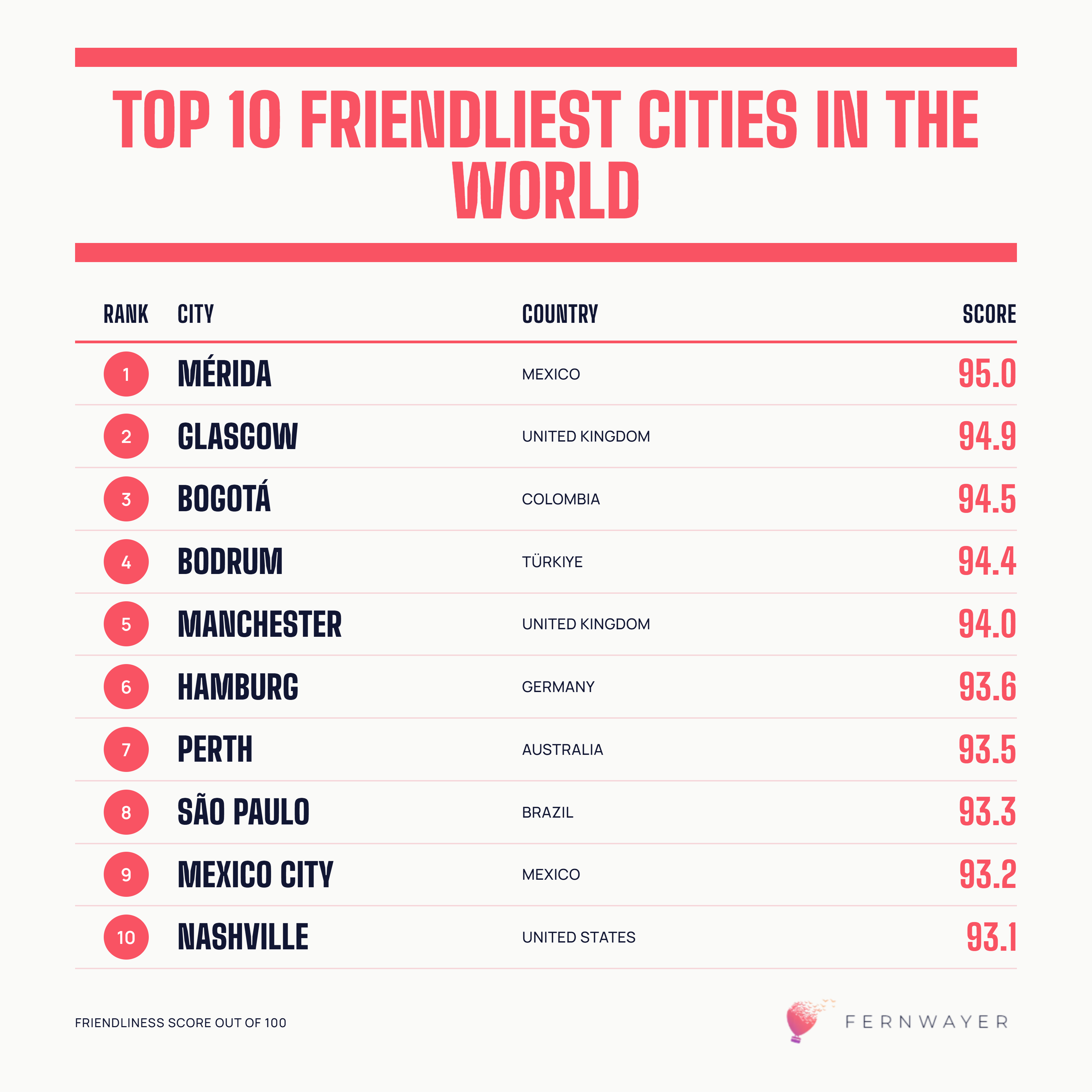
The Warmest Welcome - The Worlds’ 10 Friendliest Cities
Here are the ten friendliest cities in the world according to our analysis.
Most are secondary or provincial cities rather than capitals, the kind of place where a visitor is met as a guest rather than one of the crowd, and travelers keep reaching for the same three words: friendly, welcoming, hospitable.
The Warmest Welcome - The Worlds’ 10 Friendliest Cities
1. Mérida, Mexico (95.0). The friendliest city in the study. Comments about Mérida returned again and again to its warmth and ease, describing a Yucatán capital that has stayed human-scaled and unhurried even as more travelers discover it. Residents are "super friendly," by many accounts, and travelers repeatedly called the city "safer than any major US city." Many observed that it's “easy to integrate and make friends even as a foreigner.” Mérida comfortably outscored Mexico's other cities in the study, among them Mexico City (9th), Oaxaca (21st), San Miguel (31st), Guadalajara (51st), Puebla (90th), Tijuana (100th) and Cancún (186th).
2. Glasgow, United Kingdom (94.9) Scotland's largest city built its reputation on exactly this, to the point that "People Make Glasgow" is its official motto, and the data bears the slogan out. Travelers described an unpretentious, quick-to-chat warmth that set Glasgow apart from more-visited British cities, many finding the people "much friendlier in Glasgow than Edinburgh" (placing 157th in our ranking) and praising Glaswegians for their "personality and humour." More than one simply called them "just the best."
3. Bogotá, Colombia (94.5) Colombia's reputation for friendliness came through clearly. Visitors described Bogotá's residents as "fantastically kind and patient," forever "going out of their way to offer help when needed," a warmth that reads all the more strongly against the size and energy of the city. Bogotá also outscored the country's second city, Medellín (which ranked 15th).
4. Bodrum, Tűrkiye (94.4) A coastal town where hospitality is both a trade and, the comments suggest, a temperament, with travelers describing easy, generous encounters and a relaxed pace. Many landed on some version of the same line, that "Bodrum locals are some of the nicest and friendliest people I've ever met." Notably, Bodrum scored above Istanbul, Türkiye's largest city (ranking 33rd), highlighting the gap between primary and secondary cities that runs through much of the ranking.
5. Manchester, United Kingdom (94.0) A second British city near the top and, like Glasgow, a secondary one. Travelers contrasted Manchester's approachability with the colder, busier feel of London (162nd), and more than a few said they were "caught off guard" by how easily they struck up conversations with Mancunians. It edged out its near-neighbor Leeds (41st) too.
6. Hamburg, Germany (93.6) The friendliest German city in the study, with many visitors setting their experience against Northern Europe's reputation for reserve. The welcome they described was warm and understated rather than effusive, its people "very open minded, tolerant and welcoming to foreigners," a reminder that friendliness needn’t be loud to register. Berlin (34th), Frankfurt (69th), Cologne (77th) and Munich (102nd) were the other German cities to make the ranking.
7. Perth, Australia (93.5) One of the world's more isolated major cities, and, travelers suggested, more relaxed for it: descriptions leaned on an easy, laid-back friendliness well away from the busier eastern metros. "Incredibly laid-back" was the phrase that surfaced again and again. Perth comfortably outscored Sydney (171st) and edged the country's other strong performer, Melbourne (17th).
8. São Paulo, Brazil (93.3) The first true megacity in the top ten, and a direct counter to the idea that size dictates coldness. Even amid the scale and speed of Brazil's largest city, travelers found Paulistanos happy to help and to talk, many saying "everyone they met was so friendly." São Paulo also outscored its rival Rio de Janeiro, itself strong at 26th, along with Recife (71st) and the capital, Brasília (81st).
9. Mexico City, Mexico (93.2) The second Mexican city in the top ten, and the second megacity. Despite its enormous size, visitors described a generous, hospitable welcome, enough to carry a city of this scale close to the summit. Chilangos came across as "down-to-earth" and quick to help anyone in need, and more than one traveler marveled at how polite and friendly they were "for such a crowded city."
10. Nashville, United States (93.1) The only US city in the top ten, where Southern hospitality meets Music City: travelers described an outgoing, easy friendliness bound up with a culture of live music and conversation, and a "cool, welcoming and hospitable community." The country's ten other ranked cities spread right across the table: Chicago (19th), New Orleans (20th), Austin (25th), Houston (30th), Honolulu (40th), San Francisco (60th), New York (181st), Miami (192nd), Las Vegas (197th) and Los Angeles (199th).
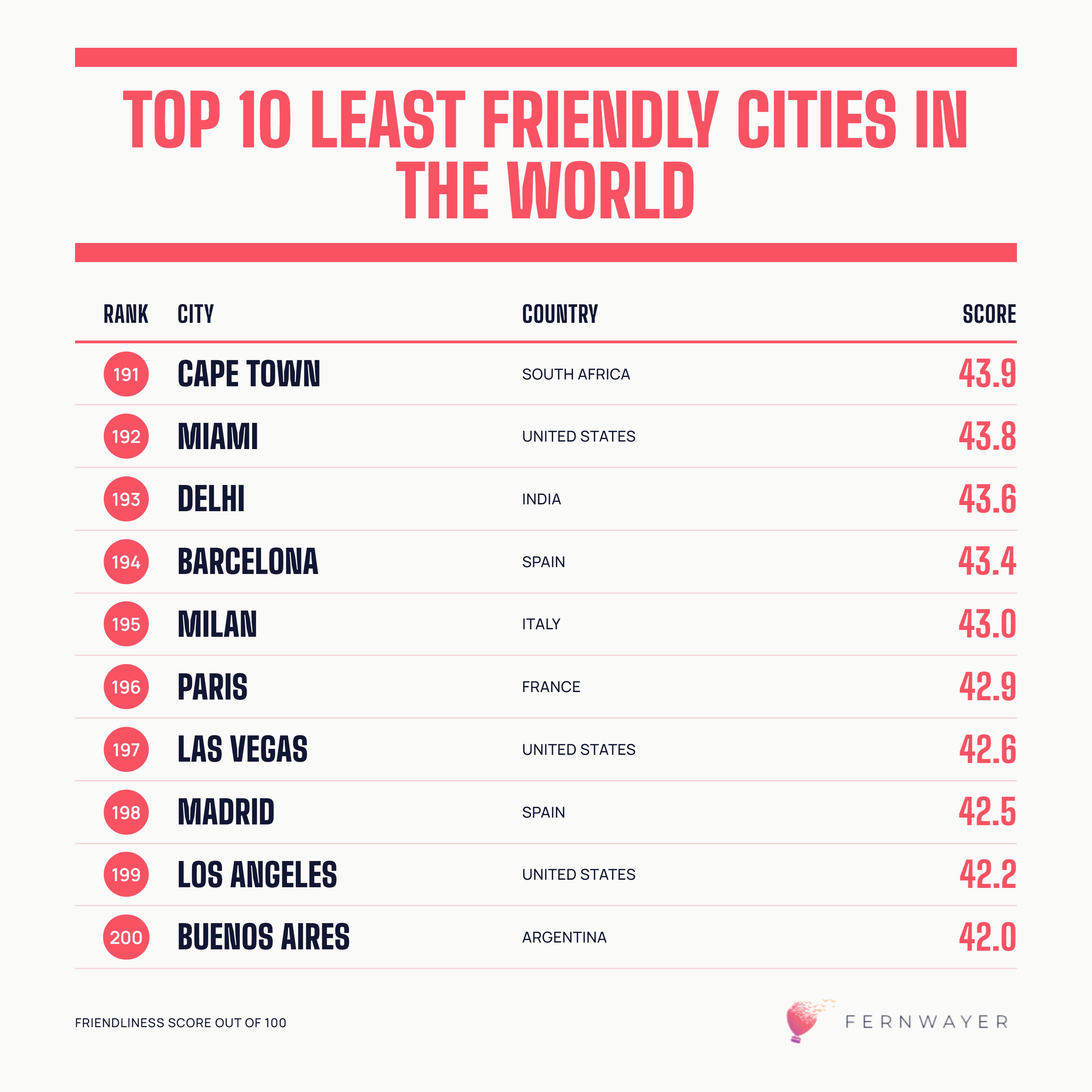
Where the Welcome Is Under Pressure - The Bottom 10
The bottom of the index is in contrast to the top 10: bigger cities, more familiar names, most of them places that many travelers already have on their list.
Some of these cities are among the world’s most-visited, and in places absorbing tens of millions of visitors a year, many travelers described exchanges as rushed, impersonal or transactional.
Where the Welcome Is Under Pressure - The Bottom 10
Friendliness by Region
Broken down by region, the Index shows the same shape repeating almost everywhere: the cities scoring the highest for friendliest are often the smaller, slower-paced ones.
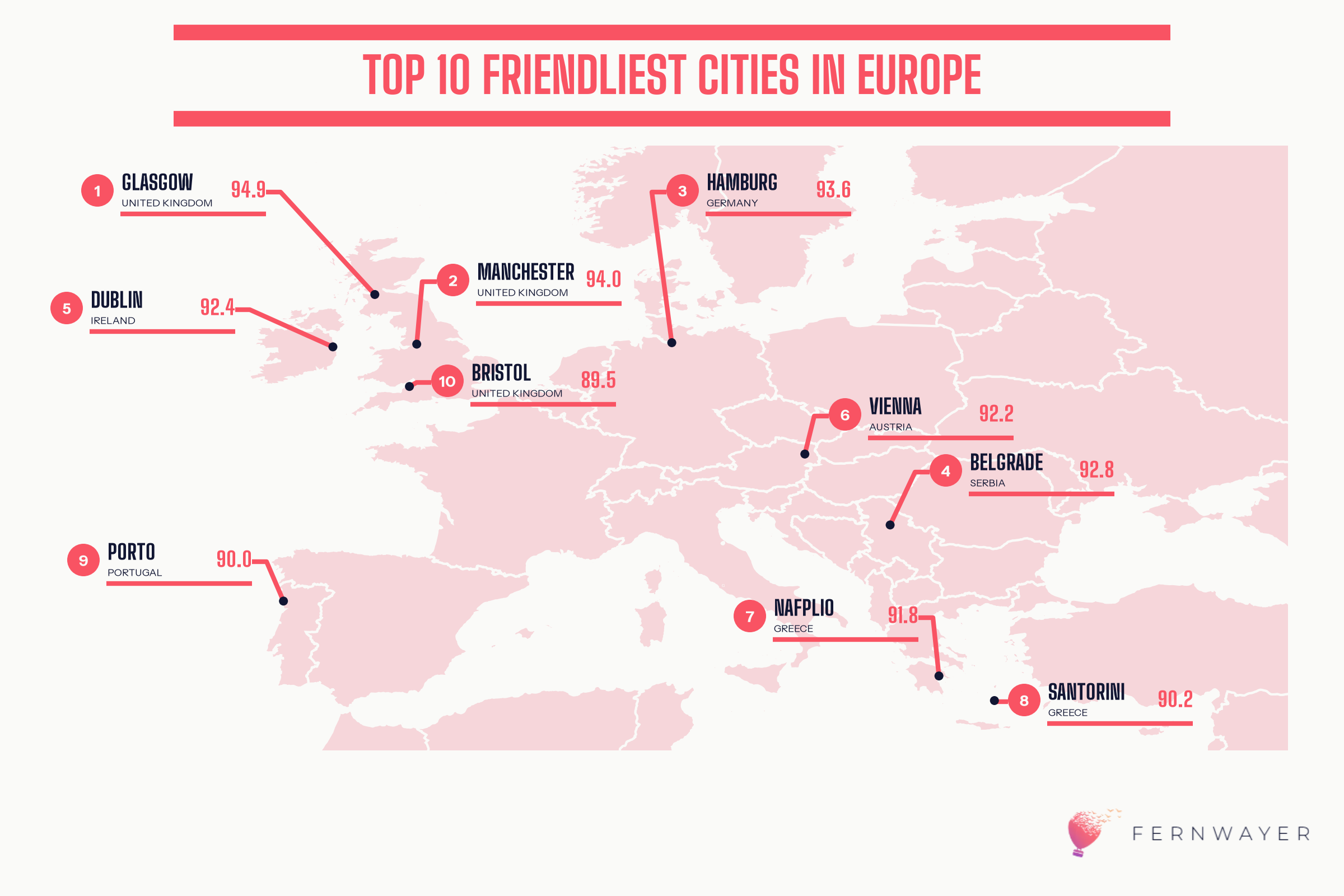
Top 10 Friendliest Cities in Europe
Glasgow leads it and ranks second in the world, with Manchester, Hamburg, Dublin and Vienna not far behind.
Top 10 Friendliest Cities in Europe
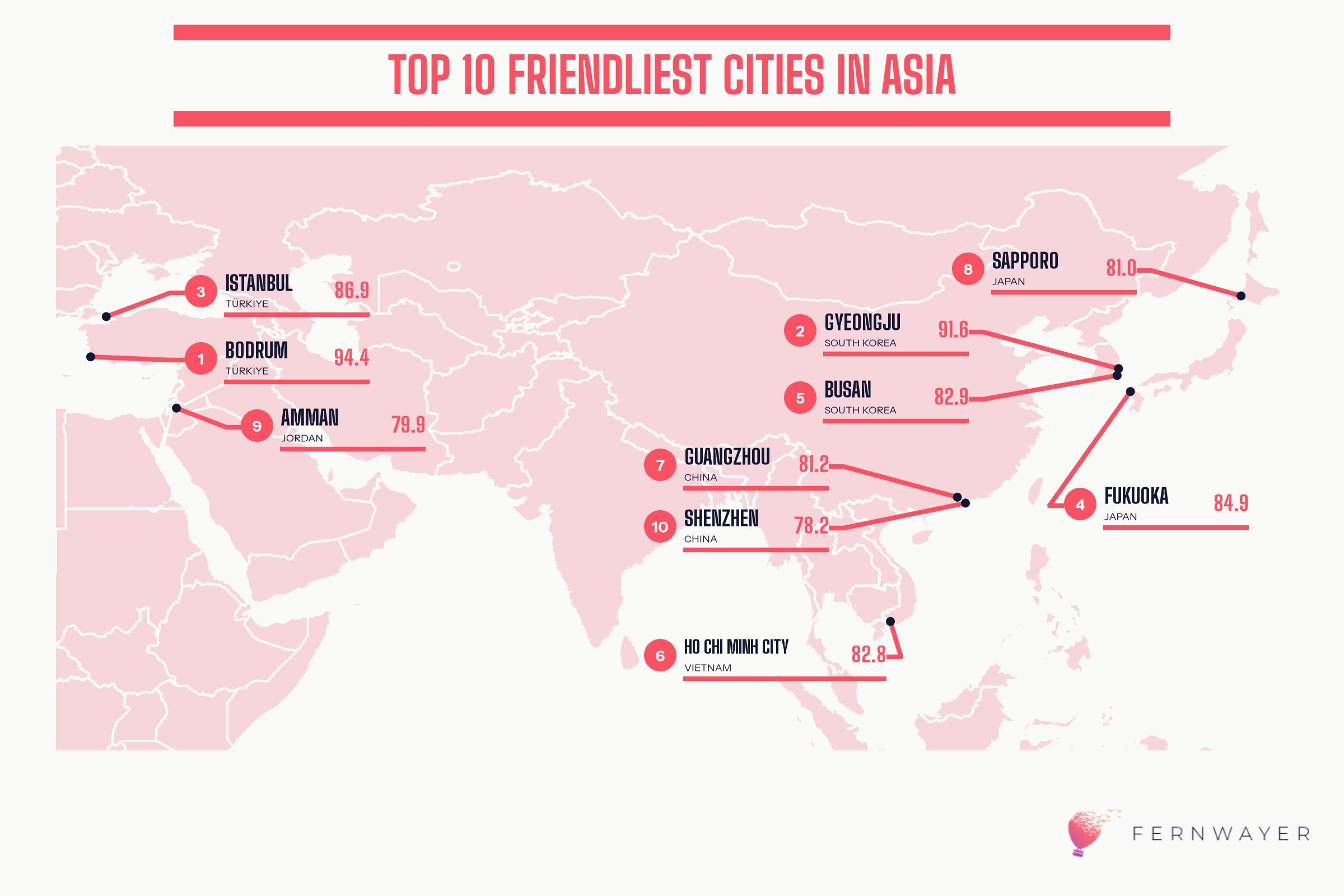
Top 10 Friendliest Cities in Asia
Asia covers the widest span of any region, from the very top of the Index to near the bottom, Bodrum (94.4) and Japan's Fukuoka and Sapporo high among the leaders.
Top 10 Friendliest Cities in Asia
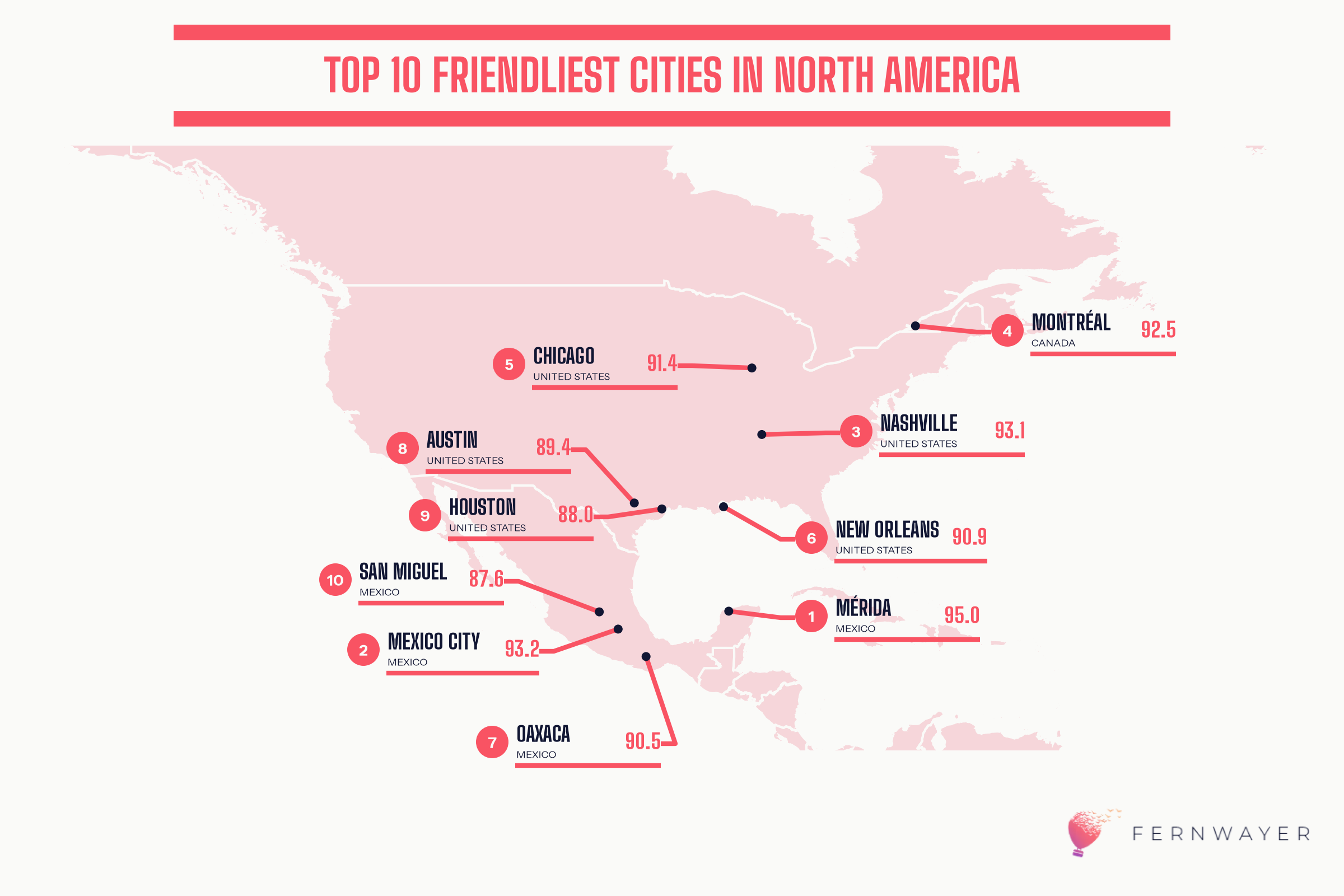
Top 10 Friendliest Cities in North America
North America produced the study's friendliest city of all, Mérida (95.0), and Mexico is the clear standout, with Mexico City, Oaxaca, and San Miguel all scoring high, joined by the easy warmth of Nashville and New Orleans.
Top 10 Friendliest Cities in North America
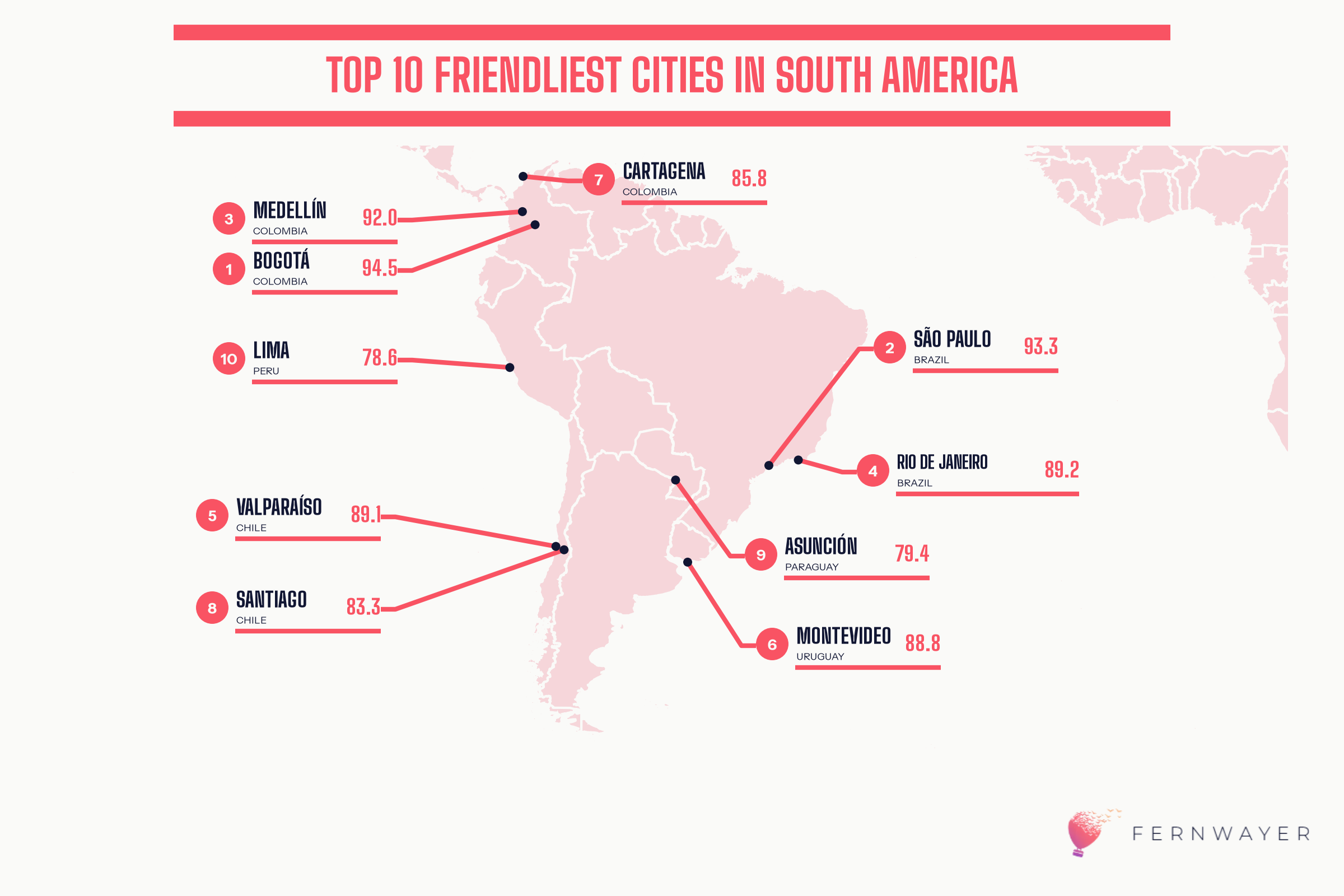
Top 10 Friendliest Cities in South America
On balance, one of the strongest-scoring regions in the study, South America is led by Bogotá (94.5), with Medellín, São Paulo, Rio de Janeiro and Montevideo close behind, a consistency of welcome that runs the length of the continent.
Top 10 Friendliest Cities in South America
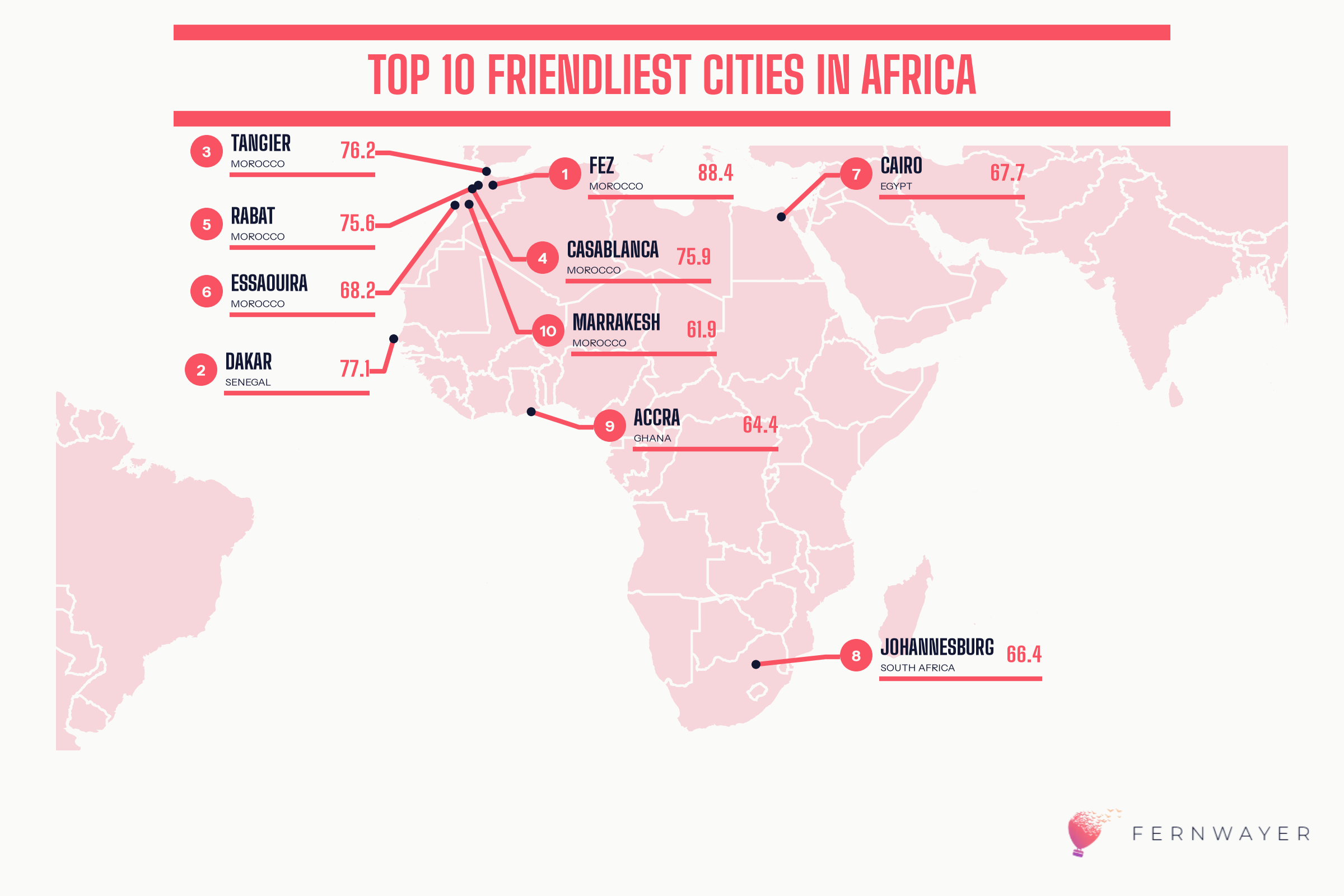
Top 10 Friendliest Cities in Africa
The hospitality of the Maghreb shines through in our study. Morocco's cities lead, Fez (88.4) highest among them, with Tangier, Casablanca and Rabat close behind, a run of warmth strong enough to define the whole region's showing.
Top 10 Friendliest Cities in Africa
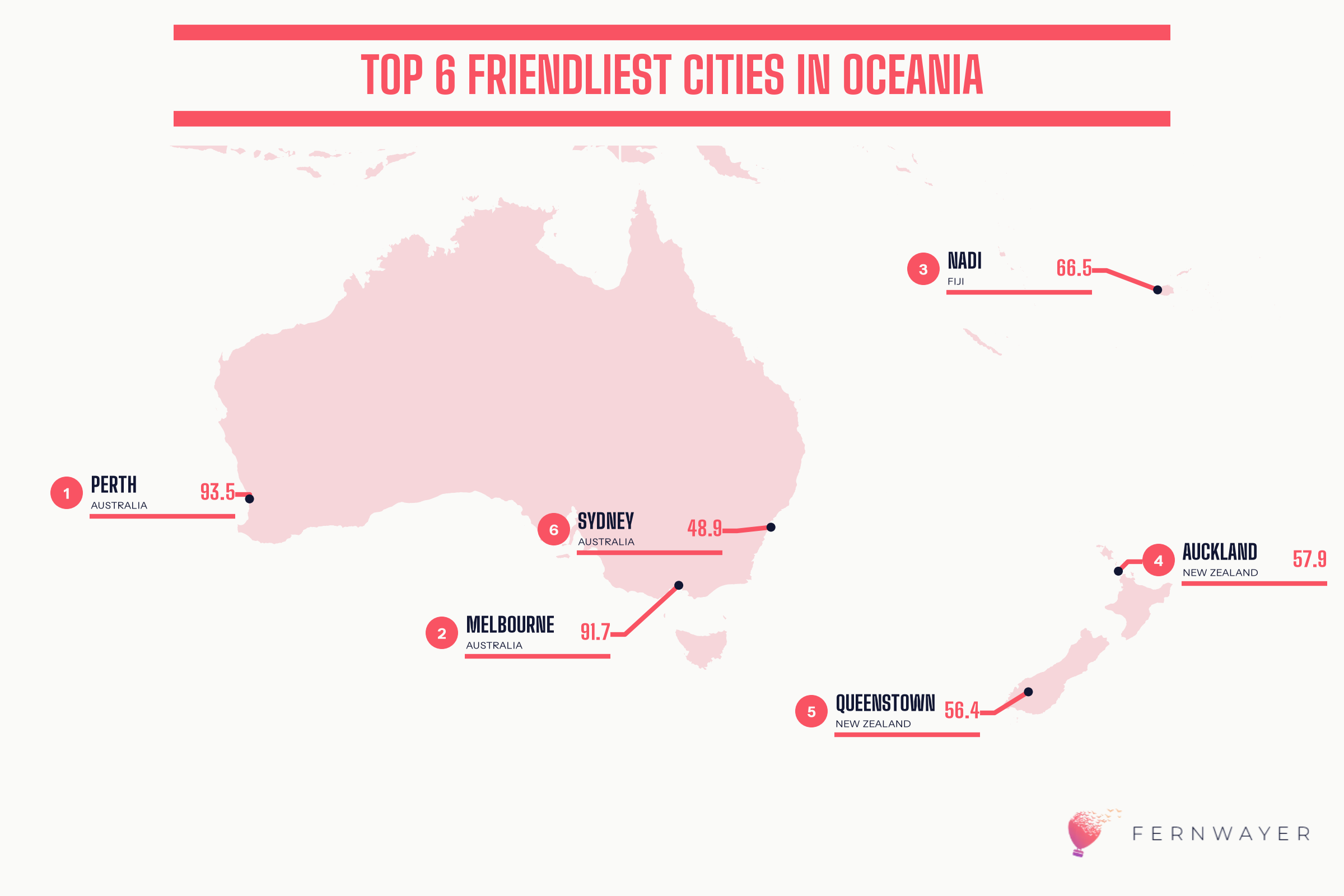
Top 6 Friendliest Cities in Oceania
Only 6 cities in Oceania made the final cut. The data turns on a clean split. Perth (93.5) ranks seventh in the world, and Melbourne is not far behind, while Sydney, Australia's busiest gateway, sits much lower, the same big-city pull seen elsewhere. New Zealand's cities and Fiji's Nadi settle in the middle of the field.
Top 6 Friendliest Cities in Oceania
Explore the Complete Rankings
What the Data Tells Us
Read across all 200 cities, the ranking is less a verdict on any single place than a set of patterns that recur too often to be chance. Three stand out.
1. A country's best-known city often scores lowest within it. In nine of the countries with several cities in the study, the capital came last of all of them, and in the most-visited countries that lowest-scoring city is often the one the world flocks to: Paris scored lowest in France, Madrid in Spain, London in the United Kingdom, Tokyo in Japan, and Buenos Aires lowest of all 200. Half the bottom twenty are a nation's capital or primary city, while the friendliest names are mostly secondary ones.
2. Cities built around visitors, rather than residents, tend to score low. Las Vegas (197th), Cancún (186th), Macau (175th), Pattaya (173rd), Phuket (169th) and Dubai (165th) gather near the foot of the table, places organized by design around entertainment, resorts and transit. Where nearly every encounter is a transaction, there is little room for the kind that is not, and much of what a traveler meets is the tourism economy doing its job rather than the place being itself.
3. Friendliness clusters by country and region. The highest scores are not scattered at random: Latin America is the strongest-scoring part of the world, with Colombia, Brazil and Mexico among the friendliest countries. The lowest averages gather among the great global hubs, financial and transit capitals like Tokyo, Hong Kong and Singapore, where a fast, international style of encounter seems to register least in what travelers write. That asks for care, though: a reserved welcome is not necessarily a cold one.
How to Find a Friendly Welcome in Any City
We put the findings to Fernwayer's founders, Vinitaa Jayson and Alok Singh, who shared their thoughts on how to find warmth and welcomeness in any location.
The study finds smaller cities scoring higher than the big capitals. Where does that leave the larger cities?
Vinitaa Jayson, Co-Founder & Chief Commercial Officer: “All cities have welcoming people, welcoming spots, and welcoming environments. The key is to discover them. You only have a limited amount of time in a place, so the challenge for travelers is: how do you find the friendliest, most welcoming way in as quickly as possible, to make the most of your time there, and not put up your defenses when a place doesn't feel friendly at the outset? That first impression is mostly transactional anyway and doesn't get to the heart of things. The surface isn't the real place.”
So even the biggest, lowest-scoring cities still have it?
Alok Singh, Co-Founder & CEO: “Even in the biggest cities, you can find warmth and friendliness and ‘welcomingness’ as we call it, but you often need someone to bring you inside that. Every city has transactional engagements that sometimes overwhelm the human connection, and you need to figure out how to work around that. But if you do, people let you enter their world, and that is where true engagement happens.”
Is any of this on the traveler?
Alok Singh: “It's a two-way street. As a traveler, you have to be curious. You have to want to connect. And in the short time you have, you need the right bridge, someone who belongs to the place and has real command of it, to make those connections.”
What does that bridge, or person, actually look like?
Vinitaa Jayson: “They're not just guides. They're photographers, fishermen, historians, chefs, architects, artisans, people with real knowledge, a real point of view, and a deep connection to the place they call home. We all arrive with our own biases, and unless you find someone like that to show you a place through their eyes, you'll leave with the same assumptions you arrived with. That's the interpretation and bridging we try to enable through every Fernwayer experience.”
How does a visitor tell genuine warmth from good service?
Alok Singh: “You have to be able to tell genuine friendliness from a transactional, service-oriented one. Just because someone has a practiced way of greeting you doesn't mean they're actually connecting with you. No one can teach you that. But you can sense whether you're being received as a friend, or just served as a customer.”
Does language get in the way?
Vinitaa Jayson: “Language matters less than people think. Just because someone speaks your language, you might assume they're friendlier or more welcoming, but fluency and real connection aren't the same thing. We've spent time in big and small places all over the map, and what we've found is that simply trying to engage, even through a translator app, where you can show someone what you're really trying to say, will open doors you never expected. Some of the most fluent people are the poorest communicators, and some of the warmest connections happen with no shared language at all.”
What turns a transaction into a connection?
Alok Singh: “You can do a transaction immediately, but a connection takes time. A big group can share information, but it can't create connection. That happens over tea, coffee, and a shared meal, and in our rush, it's often the first thing we give up. But it's the best way there is to get into someone's world. And the moment you stop being a stranger, that is the real luxury.”
The Science Behind Connecting with Strangers
When it comes to understanding how to better connect with strangers when traveling, we turned to Taylor N. West, Ph.D., a social psychologist at the University of North Carolina at Chapel Hill, who studies the benefits and barriers to connecting with strangers and acquaintances.
Why do brief, warm interactions with strangers tend to be more rewarding than we expect? Does research show a gap between expectations and reality when it comes to talking to strangers?
“Even brief interactions with strangers tend to boost our mood and sense of connection. Because strangers are unfamiliar, there is naturally some uncertainty about how interactions will unfold, and some people may worry about how they will be perceived or whether the interaction will be awkward. However, across multiple studies now we find that when people make an effort to engage with strangers, they tend to go better than we expect, and they get easier over time. “My work shows that positive moments of connection with strangers don't just feel good in the moment, but also have benefits beyond the interaction. “Strangers can also expose us to people, experiences, and perspectives outside our usual social circles. That may be especially valuable when traveling, when the people we encounter can have vastly different backgrounds and life experiences from our own.”
Do you have any advice on how to cultivate high-quality interactions and connections in places/locations with unfamiliar social norms?
“Unfamiliar social norms can also provide a natural opportunity for connection. Asking a local, even a server or bartender, about a custom, or even how to eat a particular food gives someone an opportunity to share something about their culture. Approaching these moments with genuine interest and curiosity can go a long way.”
How would you approach interacting with strangers in cultures that may seem “unfriendly” compared to what you’re used to?
“Sometimes, and in some places, people can be suspicious when people are overly friendly. This doesn’t mean they are not open to connecting, but they might take a bit more time to warm up, or to realize your intention is to be genuinely friendly. Of course, some people may not want to chat, so the important thing to keep in mind is that the goal isn’t to try and talk to as many strangers as possible. It is about being open to genuine connection and recognizing those opportunities when they arise. That could be noticing when people seem more approachable or it could be taking an interaction that is already happening and making it a bit warmer, or more meaningful.”
Methodology
To identify the world's friendliest cities, Fernwayer commissioned a study that analyzed over 1.2 million Reddit comments about 200 of the most popular tourist cities worldwide, drawn from travel, country, city and other relevant subreddit communities.
The method, in four steps:
1. We measured the language of welcome. For each city, we counted how often commenters used words like "friendly," "welcoming," and "hospitable" to describe the place and its residents, against how often terms like "unfriendly," "rude," and "hostile" appeared.
2. We built a picture of felt experience. Together, those signals showed where travelers felt genuinely embraced by residents, and where they found the local social code harder to crack.
3. We scored each city. Every comment, whether positive or negative, was reviewed and weighted to give each city a Net Promoter Score: the share of positive comments minus the share of negative comments.
4. We normalized for fair comparison. Those scores were scaled from 0 to 100 to create each city's Friendliness Score, so destinations of very different sizes could be compared fairly.